Can Communities Govern Themselves? Experimental Evidence from China's Grasslands (4.6.2026)
by Min Liu, Ming Jiang, Pengfei Liu, Jizhe Wang, Zihan Nie, Kaixing Huang, and David Wuepper (Article published in American Journal of Agricultural Economics, DOI: 10.1002/ajae.70078)
Grasslands cover nearly 40% of China's land surface and support the livelihoods of millions of herding households. They are also a textbook example of a common-pool resource: non-exclusive, rivalrous, and chronically prone to overuse. Decades of overgrazing have degraded large stretches of Inner Mongolia and the Tibetan Plateau, undermining both ecological stability and pastoral welfare. The policy response has typically followed a familiar logic: pay herders to reduce grazing, or fine them when they do not. These instruments are administratively tractable, but they carry a structural weakness — their effects depend entirely on sustained fiscal commitment and enforcement capacity. When the money stops, or when monitoring is too costly, the incentive collapses.
Meanwhile, a different tradition in institutional economics — running from Elinor Ostrom's foundational work through several decades of common-pool resource theory — suggests that communities sometimes govern shared resources effectively without external monetary intervention. The mechanism is not incentive redesign but norm formation: when community members communicate, make voluntary pledges, and build shared expectations about each other's behavior, cooperation can emerge and sustain itself. Whether this mechanism is empirically credible in real pastoral settings, and how it compares to monetary instruments in terms of ecological outcomes, income effects, and distributional consequences, is the question we set out to answer.
Research Design: A Lab-in-the-Field Experiment on the Steppe
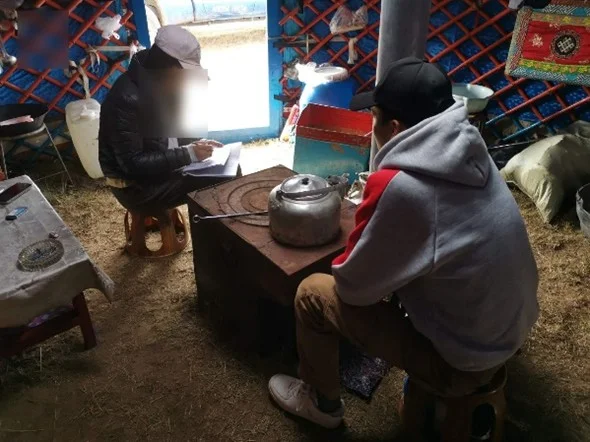
To test this question with causal rigor, we conducted a lab-in-the-field experiment with herding households in China's pastoral regions of Inner Mongolia, combining microeconomic household surveys with incentivized behavioral games. Participants made repeated grazing decisions over a shared virtual pasture — a stylized but structurally faithful representation of the collective-action problem they face every day.
We randomly assigned households to one of three institutional treatments, plus a control group that received no intervention. The reward treatment provided monetary bonuses to herders who reduced grazing below a threshold. The punishment treatment imposed financial penalties on those who exceeded it. The communication treatment allowed herders to talk, make voluntary pledges, and coordinate their decisions before acting — with no external financial stakes attached. The random assignment across villages ensures that differences in outcomes across groups can be interpreted causally, without concern that pre-existing differences in community cohesion or ecological conditions confound the comparison.
Results: Informal Organization Matches Monetary Instruments — at a Fraction of the Cost
The headline result is perhaps surprising. All three treatments significantly improved grassland conservation outcomes relative to the control group. More striking, none of the three outperformed the others in ecological terms: informal organization achieved the same conservation effect as monetary rewards or financial penalties.
The differences emerge when one looks beyond the ecological outcome. The reward mechanism raised total household income by approximately 29% — the strongest income effect across all treatments — but it widened inequality between households and required continuous public expenditure to sustain. The punishment mechanism reduced net herder income on balance, changing behavior through the fear of loss rather than the prospect of gain. Informal organization increased total household income by around 10% and produced no measurable increase in inequality. Critically, it required no public fiscal commitment whatsoever.
Why Communication Works: Beliefs, Not Just Incentives
The mechanism analysis points to what is, in our view, the most important finding. Only the communication treatment significantly changed herders' beliefs about others' behavior — specifically, their confidence that fellow community members would also choose to cooperate. In the communication treatment, 81% of participants voluntarily chose low-intensity grazing. We find no evidence of strategic deception or cheap talk: when herders pledged to cooperate, they followed through.
Rewards and punishments, by contrast, operated entirely through the external cost-benefit calculus. They altered behavior without altering beliefs about others. This distinction has substantial implications for policy durability. An institution that builds genuine cooperative norms — shared expectations, mutual trust, voluntary commitment — does not depend on continued external support to function. One that simply changes incentives is only as durable as the incentive itself.
This finding connects to a broader literature on social norms and collective action. It suggests that in pastoral communities, the latent capacity for self-governance is not merely theoretical. Under the right conditions — opportunities for communication, a credible commitment device, and sufficient social cohesion — it can produce outcomes that match externally imposed instruments at lower cost and with more equitable distributional properties.
Implications for Grassland Policy
These results have direct relevance for how grassland conservation programs are designed, both in China and elsewhere. China's Grassland Ecological Conservation and Reward Program (GECP) currently covers hundreds of counties and disburses billions of yuan annually in direct subsidies to herders. As the program comes up for review and redesign, our findings suggest two conclusions worth taking seriously.
First, monetary instruments alone are not necessary for effective conservation. Community governance mechanisms can achieve equivalent ecological outcomes at lower fiscal cost and with more equitable distributional effects. Second, and more subtly, the mechanism through which an instrument works matters as much as whether it works. An instrument that changes incentives without changing norms is fragile; one that builds cooperative expectations can become self-sustaining over time.
This does not mean payments and penalties have no role. In settings with weak social cohesion, fragmented communities, or extreme inequality, informal coordination may be insufficient, and external instruments remain necessary. But the assumption that monetary incentives are the only credible policy lever — an assumption embedded in most grassland policy design — deserves to be challenged. The results suggest that policy designs combining formal economic instruments with deliberate support for community coordination mechanisms may outperform either approach in isolation.
More broadly, the challenge of governing degraded commons under fiscal constraint is not specific to China. From the Sahel to Central Asia to the Andean highlands, pastoral communities face structurally similar collective-action problems with similarly limited state capacity. The evidence that informal organization can achieve conservation parity with monetary instruments, at zero fiscal cost, is a finding worth taking seriously in policy debates well beyond China's borders.
Reference
Liu, M., Jiang, M., Liu, P., Wang, J., Nie, Z., Huang, K., & Wuepper, D. (2026). Performance of Reward, Punishment, and Communication in Common-Pool Resource Management: Evidence from Grassland Conservation in China. American Journal of Agricultural Economics, 1–26. https://doi.org/10.1002/ajae.70078