

Curriculum Master Planetary Health
The master program covers:
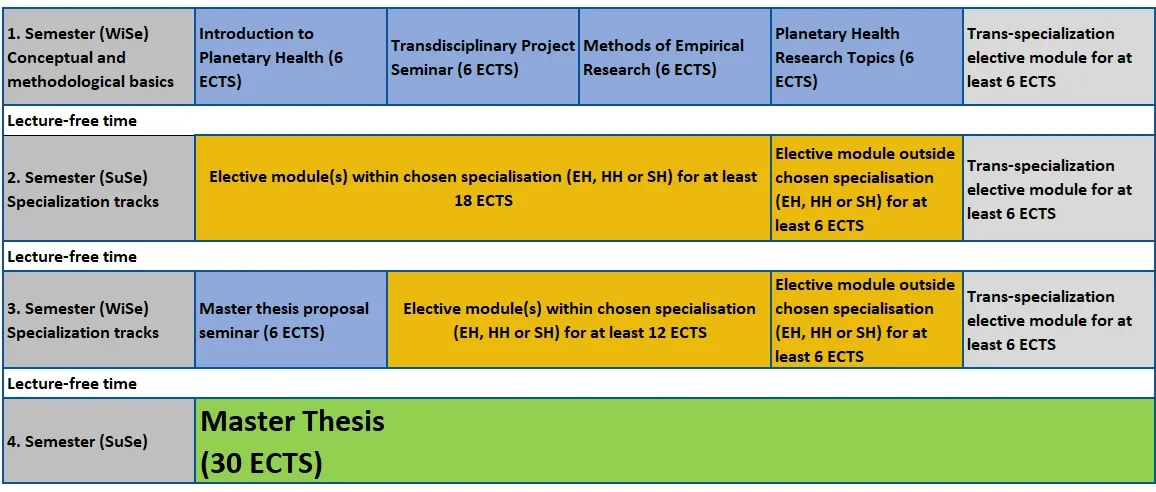
5 Compulsory modules with a total of 30 ECTS (credit points):
Introduction to Planetary Health, Transdisciplinary Projects Seminar, Methods of Empirical Research, Planetary Health Research Topics, and Master thesis proposal seminar.
Electives within the field of specialisation (Environmental Health, Human Health or Societal Health) with a total of minimum 30 ECTS (credit points).
2 "Interdisciplnary" Elective modules taken outside of the field of specialisation with a minimum total of 12 ECTS (credit points), and 3 "Trans-specialisation" modules with a total of minimum 18 ECTS (credit points)
The trans-specialisation modules are either methods-based or foster trans-disciplinary and ethical thinking.
1 Master Thesis with a total of 30 ECTS.
The thesis must be written on a topic linked to the chosen field of specialisation.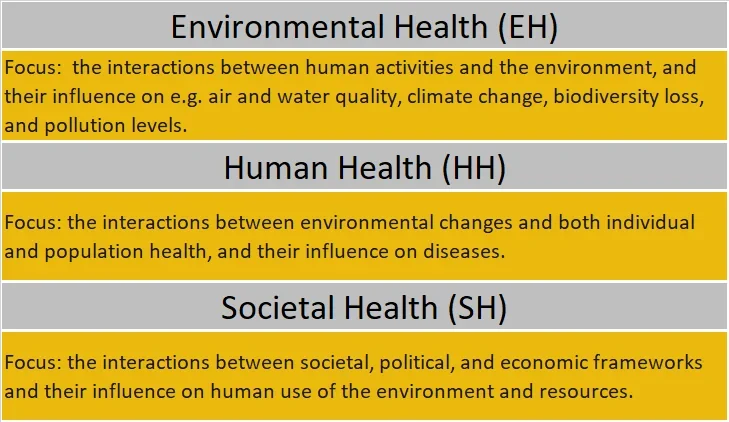
Planetary Health students must choose a field of specialisation, starting from the second semester.
Worth a minimum of 30 ECTS, the specialisation together with the master thesis (30 ECTS) ensure that students gain the necessary disciplinary skills to qualify for a doctoral program in their discipline. Combined with the 60 ECTS gained across other inter- and trans-disciplinary courses and seminars, students become true Planetary Health experts.
The choice of specialisation should be guided by the student's academic background (the bachelor degree) and own interests, in consultation with the MSc Planetary Health program coordinator.
Characteristics of the Specialisations
In this specialisation, students learn to integrate concepts and methodologies from climate, soil or environmental sciences as well as physical geography. Topics covered are for example: Integrated Approaches to Ecosystem Health, Climate Dynamics, Soil Resources, The Triple Planetary Crisis, Global Water Resources, Environmental Systems and Change, Spatial Analysis, Modelling and Simulations, Scenario Building and Forecasting.
In this specialisation, students have a main background in global health, public health, health services and delivery, medical sciences, epidemiology or nutrition.
Topics covered include: Nutrition and Chronic Diseases, Epidemiology, Food Security, Ecologies of Health and Diseases, Public Health, Sustainable Healthy Diets.
In this specialisation, students learn to apply concepts and methodologies from the social sciences, business studies and economics to investigate planetary health issues. Their main background is human geography or any field in economics, including e.g. agricultural, environmental, development or business economics. Examples of topics covered are: Sustainability Economics, Sustainable Technologies and Businesses, Agricultural Transformation, Impact Evaluations of Development and Environmental Policies, Microeconomic and Econometric Analysis, Development and Globalisation.
Planetary Health Contact
Katrin Gleisberg-Gerber
Nußallee 21
53115 Bonn
The Research Groups (and staff) behind the MSc Planetary Health
Here you find listed all the research groups who are teaching in the MSc Planetary Health. Various staff members are involved, but you can always contact the group leader for more information - they are also involved in the teaching. To have more information about the groups, please contact them directly using the button - it will guide you to the correct webpages.
We analyse the behavior of consumers and other stakeholders in the agri-food value chains in order to gain knowledge about how the transformation process of achieving the necessary sustainability goals can be promoted. To the research group
At the group, we study the reponse of ecosystems in general, and biodiversity in particular, to changes in land use and landscape structure. To the research group
In the research group, we integrate diverse perspectives and disciplines to address the complexities of land use decisions and their impacts on biodiversity and livelihoods. To the research group
Our research focuses on the dynamics of the atmospheric boundary layer, i.e. the layer that is in direct contact with the Earth's surface. We use modern in-situ observation techniques to study exchange processes between air and water and between air and land, e.g., the exchange of momentum, heat, moisture, and gases. To the research group
The overarching aim of the group is to support the development of sustainable crop and farming systems under current and future climate conditions, to improve food security while minimizing negative environmental impacts. To the research group
The research of our group focuses on developing and applying novel data science tools in the area of agricultural and environmental economics. To the research group
The research group explores the interlinkages between climate change and human development. By examining how development affects the extent to which people are likely to be affected by climate change, we seek to address the question of whether fair and just development is possible in a changing climate. To the research group
Our group explores processes of socio-ecological change and how they shape the lives, livelihoods, landscapes, and identities of local people, primarily but not exclusively in the Global South. To the research group
The group focuses on ecohydrology, water in global change, complex human-water relationships, and natural hazards and risks. To the research group
The group focuses its research on analysing agricultural and food policies. While continuing research on more traditional agricultural policy issues, newer projects cover environmental impacts of agriculture, rural development issues and trade in agricultural and food commodities. To the research group
The group focuses on sustainable economic development and the reduction of poverty, malnutrition, and inequality. The current research program has a strong focus on economic and social aspects of food and nutrition security, sustainable agriculture and food systems, technical and institutional innovations, and rural development. To the research group
Our research group assesses and evaluates the impacts of environmental policy instruments, natural resource governance, and bioeconomic transformation on land use, ecosystem services, and rural development. To the research group
The group investigates entrepreneurial behaviour, particularly within sustainability-oriented and regenerative entrepreneurship. A key focus is on how entrepreneurs can become essential solution providers for ecological and social challenges. To the research group
The group conducts research in strategic (e.g., leadership styles, new business models, organizational culture), behavioral (e.g., employee behavior, psychological decision-making behavior), and algorithmic (e.g., novelty measurement, impact analyses) technology and innovation management. To the research group
The group focuses on understanding the interaction between ecosystems and the atmosphere, with a special focus on exchanges of trace gas fluxes. To the research group
The main objective of our research is to contribute to a fundamental understanding of how quickly and through which mechanisms soils degrade, and how we can restore their properties and functions for sustainable plant production and land use. To the research group
The Research Group is focusing on mountain permafrost, sediment budgets, late- and postglacial landscape development, natural hazards and risks as well as Global Environmental Change. To the research group
The Centre has the tasks: to scientifically elaborate the normative foundations of qualified judgement formation and to make them available in various formats; to prepare and make available information from a wide variety of fields on the current bioethical discussion in science, society and politics; to promote scientific networking and thus advance the German, European and international discourse. To the research group
The group’s research addresses processes in the critical zone and landscape function, with a particular focus on hydrological processes, models and Ecohydrology. To the research group
Our research group focuses on life science data (mainly biomedical and agricultural data) and develops text and data mining techniques such as Semantic search in publications, Extraction of information and knowledge from literature or databases, Data mining and machine learning / deep learning applications in heterogeneous data sets. To the research group
The main objective of the group is to provide evidence-based policy recommendations for the management of the natural resource land. We use and produce global data on land conditions and dynamics, identify the causal effects of public policies, analyze which cultural, institutional, and market factors interact with them, and evaluate the potential of technological solutions. To the research group
The group conducts population-based research into the interrelations of climate change and other planetary systems with dietary behaviour, nutritional status, and human health. To the research group
The Production Economics Group strives to identify pathways towards more sustainable and resilient agricultural and food production systems – and to quantify the potential impacts and trade-offs of such transformations. To the research group
The group explores how to make governing environmental commons more effective, which requires understanding how people and nature are connected in context specific ways, shaping what types of rules and norms work for governance locally. To the reserch group